"A Practical Segmentation of AI Startups for Business Angels"
Introduction
The artificial intelligence (AI) revolution creates a multitude of investment opportunities but also generates some confusion in the terminology. Here is a clear and actionable segmentation to structure your discussions and investment analysis.
France Digitale recently published a new edition of its sector mapping, carried out with the support of Sopra Steria Ventures, the financial arm of the group specialized in digital transformation of companies.
Why a New Taxonomy of AI Startups?
Traditional sector classifications (fintech, healthtech, etc.) are no longer sufficient. An AI startup in health might have more similarities with an AI startup in finance than with another healthtech without a significant AI component.
As an investor, understanding how a startup uses AI, rather than where it applies it, allows you to:
- More accurately evaluate its value proposition.
- Anticipate its specific challenges and capital needs.
- Identify truly differentiating teams.
- More accurately estimate its potential for scalability.
The Model: A Strategic Pyramid
I propose a model to map the AI startup ecosystem. This pyramidal approach identifies six distinct categories of startups, each with its own characteristics, challenges, and investment opportunities.
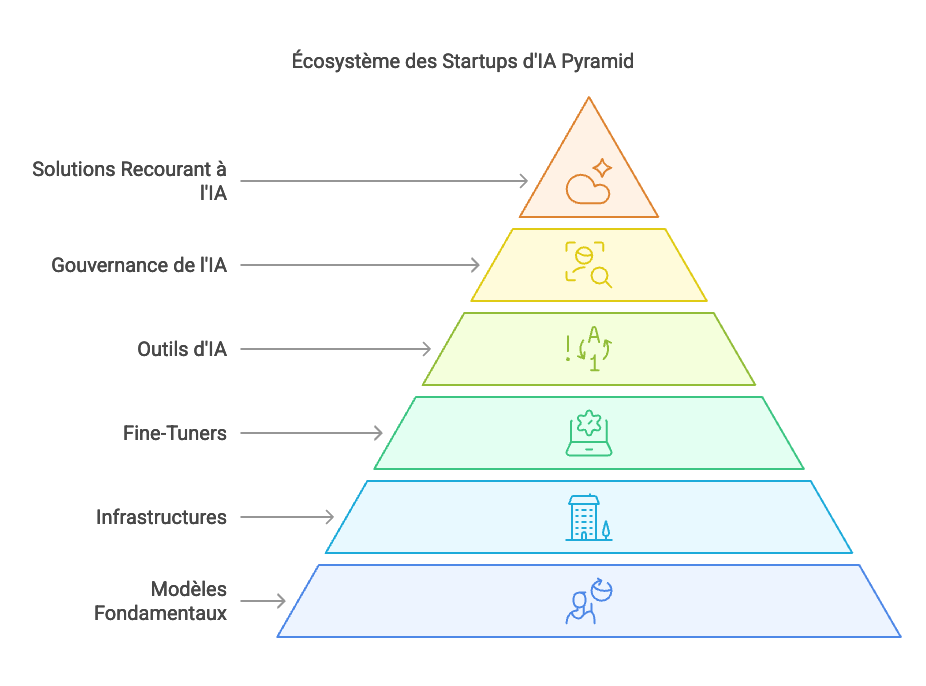
1. Fundamental Models - The Architects
These startups develop the basic models that power the entire AI ecosystem. They are comparable to microprocessor manufacturers of the 80s: few in number, but essential.
Key characteristics:
- Elite research teams with expertise in deep learning.
- Massive computing power needs.
- Long and costly R&D cycles.
- Potential for revolutionary intellectual property creation.
Opportunities and risks:
- Very high risk/reward investment.
- Considerable barriers to entry (talent, capital, infrastructure).
- Potential for major disruption, but uncertainty about monetization.
Notable Examples: OpenAI, Mistral AI, Anthropic, Cohere.
💡 Investor Tip: Reserve these investments for your "moonshot" portfolio and prepare for long horizons. Sector consolidation is inevitable - only a few players will dominate. Existing players have access to considerable funds in the billions of euros.
2. Infrastructure - The Builders
These startups provide the technical foundations necessary for the effective deployment of AI on a large scale, a sector often overlooked but critical.
Key characteristics:
- Specialized computing and hosting solutions for AI.
- Model management and orchestration platforms.
- Tools for performance optimization and monitoring.
Opportunities and risks:
- B2B market with predictable economic models.
- Durable and recurring customer relations.
- Fierce competition with cloud giants.
Notable Examples: Hugging Face, GCP, Azure, Scale AI, OVHcloud AI.
💡 Investor Tip: Look for solutions that solve specific AI problems that generalist infrastructures struggle to address.
3. Fine-Tuners or Adapters - The Specialists
These startups customize and optimize generic models for specific use cases, thus creating significant value.
Key characteristics:
- Deep expertise in a vertical domain.
- Mastery of fine-tuning and adaptation techniques.
- Specialized and proprietary data collections.
Notable Examples: Perplexity AI, Aidence (medical imaging).
💡 Investor Tip: Evaluate the quality and uniqueness of the data the startup has.
4. AI Tools - The Facilitators
These startups simplify access to AI technologies by offering easy-to-integrate programming interfaces. These companies belong to the category of startups that facilitate the use of artificial intelligence technologies by offering standardized and easy-to-use interfaces (APIs). They take care of the underlying infrastructure and deployment, thus allowing other developers and companies to integrate AI features into their own products and services without having to build the AI models themselves.
Key characteristics:
- Standardized APIs for various AI functionalities.
- Robust infrastructure for deployment and scaling.
- Usage-based economic models (pay-as-you-go).
Notable Examples: Fireworks.ai, Together.ai, replicate.com, Bolt, Lovable
💡 Investor Tip: Look for distinctive offerings beyond mere access to models.
5. AI Governance - The Guardians
These startups develop solutions to ensure ethical, transparent, and compliant use of AI.
Key characteristics:
- Tools for bias detection and mitigation.
- Solutions for explainability and algorithmic transparency.
- Regulatory compliance platforms.
Notable Examples: Giskard, Jumple, Holistic AI.
💡 Investor Tip: Closely follow regulatory developments.
6. AI-Utilizing Solutions - The Users
These startups integrate AI to create products that solve specific problems across various sectors, bringing real added value.
Key characteristics:
- A combination of sector expertise and technological capability.
- Ability to translate AI capabilities into tangible benefits.
- Focus on user experience and integration into existing workflows.
Opportunities and risks:
- Vast market but quickly heading towards saturation.
- A need for clear differentiation beyond the "AI effect".
- Vulnerability to changes in underlying APIs and models.
Notable Examples: Notion AI, Alan (insurance), Doctolib (with AI features).
💡 Investor Tip: Favor startups where AI amplifies a preexisting competitive advantage.
Investment Trends to Watch
- Rise of specialized models: AI designed to excel in specific fields (legal, medical, financial).
- Cost optimization: Solutions reducing the cost of using AI.
- Data sovereignty: Solutions compliant with European regulations.
- Embedded AI: The integration of AI in autonomous devices (edge computing).
Conclusion
Use this segmentation to structure your investment thesis, diversify your portfolio, and tailor your evaluation criteria for each category.
Leave a private comment
Have a question or feedback? Send me a private message directly. It won't be published.