"Startups and AI: Between Mirage and Revolution"
Some believe that all startups will be replaced by AI-based solutions ("SaaS is dead"). Others claim that startup investment is over because valuation will go directly to model creators (OpenAI, Google, etc.) and startups will have negligible margins. Let's try to see more clearly and revise our investment strategies if necessary (also read Fake AI?) .
Here are the risks I dismiss and those to consider for better guiding our decisions.
Risks I Dismiss
AI Will Have a Negligible Impact
Artificial intelligence (AI) profoundly transforms the startup landscape by democratizing access to capabilities previously reserved for large corporations. Now, even small structures can automate complex tasks, analyze large amounts of data, and personalize their services on a large scale with limited resources. This technology promotes agility, innovation, and opens up to new business models.
AI will have a significant impact on startups.
Margins Concentrated on Models
The idea that model creators (like OpenAI or Google) will capture all the margins is debatable for several reasons:
- This phenomenon already exists in other sectors, for example with online advertising. Startups have to pay for their visibility, but this has not prevented the emergence of many successful companies.
- The ecosystem will find a balance: if margins are too low, there will be fewer startups, which will also reduce revenue for model creators.
- The competition among AI model creators is intense. Costs will decrease and open-source models could play a key role.
According to a podcast by Theory Ventures, recent figures show that:
- AI improves the gross margins of SaaS companies.
- The growth rates of AI startups are faster than those of traditional SaaS.
- With improved margins, valuations could see significant expansion.
SaaS is Dead
Satya Nadella said that “SaaS is dead.” Should we stop investing in B2B SaaS? I don't believe so. What he means, rather, is that traditional SaaS (not based on AI agents) will be replaced by "agentized" SaaS. The real danger is the acceleration of innovation.
Real Risks
AI Washing
AI washing occurs when companies claim to use AI without real added value. Some exaggerate the effectiveness of their AI or integrate elementary technologies presented as revolutionary.
Unfulfilled Promises
An AI model is only as good as the data and the engineering process that support it. Deploying an operational AI solution in the real world remains a major challenge.
Ethical Issues
Regulations, such as the EU AI Act, strengthen requirements for transparency and compliance. Due diligence teams must be extra vigilant when evaluating AI startups.
Weak Value Proposition or Poor Differentiation
In a saturated market, startups must offer clear and differentiated advantages. Customers and investors are looking for solutions capable of effectively solving specific problems.
Evolution of the Value Proposition
The value proposition—over time—is the most difficult point to assess for an AI startup. Let's list the trends or strategies that can influence this assessment.
Agentization of Applications
Satya Nadella stated that "SaaS is dead". This means that traditional SaaS will be replaced by applications based on intelligent agents. Innovation is accelerating, profoundly changing business models.
From Web 1.0 to Web 4.0
- Web 1.0: Static web of the 1990s.
- Web 2.0: Social web.
- Web 3.0: Decentralized web based on blockchains.
- Web 4.0: Web based on intelligent agents.
Non-agent-based solutions risk being quickly disrupted. For investors, it is essential to anticipate this acceleration of innovation.
Many current SaaS are “databases with a lot of business logic.” They will be replaced by SaaS applications based on agents.
Rapid Improvement of AI Models
Sam Altman - "I think fundamentally there are two strategies to build on AI right now there's one strategy which is assume the model is not going to get better and then you kind of like build all these little things on top of it... and then there's another strategy which is built assuming that the models are going to stay on the same rate of trajectory and the models are going to keep getting better at the same pace."
Therefore, there are two main strategies for AI startups:
- Build on the basis of existing models without anticipating their improvement. These startups will focus on enhancements to improve customer experience.
- Assume that the models will continue to improve rapidly and adapt their offer accordingly. Find a niche where the AI is already satisfactory and expand the scope with model improvements.
Clearly, betting on the second type of startups is essential.
To learn more about startup strategies in AI, I highly recommend the interventions of Sam Altman (CEO of OpenAI): his in-depth conferences on entrepreneurship in AI (here, here, here, and here), as well as his concise explanations on the two main strategies for startups building on AI (part 1 and part 2).
Not All Value Chains are Equal
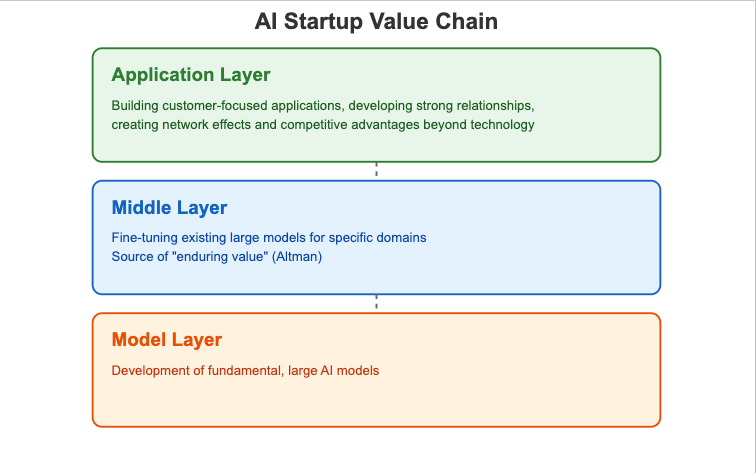
AI Model Creators
There will probably be few large fundamental models, but these will serve as a foundation for other innovations. Currently, companies offer APIs based on their models, allowing others to build services on top of them.
To avoid for early-stage investments.
The intermediate layer
An intermediate layer will become essential: startups will take existing models and customize them extensively. This will create opportunities for specialized solutions in various sectors, such as medicine or virtual assistants. This layer will provide lasting value.
Tools above existing models
Create tools to facilitate the use of AI. To create a sustainable and differentiated business, they must focus on 2 points:
- Focus on understanding the market and customers. There will always be a market for products that solve specific customer problems.
- Create a competitive advantage. These advantages are not always technological. It can be a “network effect” or any other form of differentiation.
Leave a private comment
Have a question or feedback? Send me a private message directly. It won't be published.